Article Directory
So, "Plasma" is the new thing.
And if you’re asking “what is plasma,” the answer you get depends entirely on which corner of the internet you’re in, and who’s trying to sell you what. Because last week, the word simultaneously referred to a multi-billion dollar crypto launch, a breakthrough in astrophysics, and a new way to sculpt laser beams.
And, you know, the yellowish stuff in your blood. Let’s not forget that one.
One of these things is not like the others. I’ll let you guess which one I’m talking about.
A Five-Alarm Dumpster Fire in a Billion-Dollar Tuxedo
The One With All the Money
Let’s start with the one making all the noise. A new blockchain called Plasma—backed by the ever-so-reputable Bitfinex—burst onto the scene. Its token, XPL, hit the big exchanges and immediately rocketed to a market cap of over $2.8 billion. Its main feature, a "savings" vault, sucked in $2.7 billion in deposits in its first 24 hours.
Two-point-seven billion. In a day.
They’re promising a 20% APY on USDT, which is crypto-speak for "magic internet money interest rate that is totally sustainable and definitely not propped up by hype and venture capital." The whole thing became the seventh-largest chain in DeFi overnight.
Aave founder Stani Kulechov cheered it on, saying, “Plasma is a prime example of how Aave works as a flywheel for liquidity.”
Let me translate that from PR-speak into English for you: "Thank you for providing the exit liquidity for our friends and early backers."
This is a bad idea. No, 'bad' doesn't cover it—this is a five-alarm dumpster fire dressed up in a tuxedo. We've seen this movie before. A flashy launch, insane yields pulled from thin air, a tokenomics structure where 50% of the supply is reserved for founders and "early backers" with a one-year lockup. I wonder what happens in 366 days? It’s a mystery wrapped in an enigma, funded by your FOMO.
They call their neobank "Plasma One." They talk about "gasless transfers." It all sounds so sleek, so futuristic. They picked a name that sounds like it belongs in a physics textbook. And I think I know why.
Putting a Lab Coat on a Slot Machine
The One With the Actual Physics
Because on the exact same day all this crypto nonsense was trending, a paper was published in a journal called Ultrafast Science. A team from Peking and Hunan Universities figured out how to generate powerful terahertz pulses from, you guessed it, magnetized plasma.
I’m not going to pretend I understand the half of it. They’re talking about Poincaré beams, spin and orbital angular momentum, and field strengths of 150 MV/cm. Prof. Xueqing Yan said, “The natural anisotropy of magnetized plasmas enables us to enhance THz intensity while sculpting its polarization topology.”
Right. Offcourse.
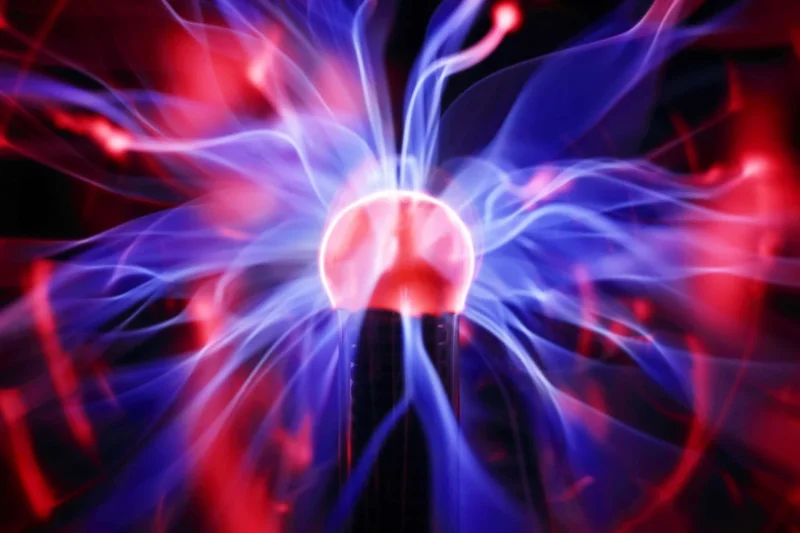
Then, just a few days earlier, another group of scientists at KU Leuven published their findings on plasma. They managed to create the first-ever simulation of turbulent plasma in a "true steady state." This is apparently a huge deal for understanding things like black holes and pulsars, which first author Evgeny Gorbunov called a "universal cosmic particle accelerator."
So, in one week, the word "plasma" was used to describe:
1. A crypto casino promising impossible returns.
2. A method for creating topologically tunable laser beams.
3. A simulated cosmic particle accelerator that helps explain the universe.
This ain't a coincidence. This is a branding strategy.
The crypto guys aren't stupid. They know what they're doing. They're not naming their project "Magic Bean Stalk Finance." They're borrowing the language of hard science. They're wrapping their highly speculative financial product in the credibility of astrophysics. They’re banking on the fact that your brain will hear "plasma" and think "complex," "powerful," "the future," and not "a way for VCs to dump their bags on you."
It’s like when I was a kid, my dad tried to explain how our old plasma TV worked. He got halfway through talking about noble gases and electrodes before giving up and saying "it's just magic." That's the level of understanding they're counting on. They want you to see the complicated words and just nod along.
When a Buzzword Kills a Real Word
And Don't Forget the Other One
And this whole mess completely ignores the one definition of plasma that most normal people might actually encounter. You know, `blood plasma`. The real stuff. The component of your blood you can actually `donate plasma` for at a `plasma center` like `Biolife` or `CSL Plasma`. It has an actual `plasma function`, like carrying proteins and hormones through your body.
You can look up `plasma donation near me` and find a place run by `Grifols` or `Octapharma` where you can, for a small fee, help save a life. It's a tangible, physical thing. It’s not an abstract financial instrument or a simulation of a star.
But now the word is hopelessly polluted. The search results are a mess of crypto hype, dense scientific papers, and clinics asking for your arm. It’s a perfect storm of confusion, and in that confusion, the loudest and most well-funded voice wins. And right now, that's the crypto voice.
They expect us to believe that their token, with its 40% allocation to "ecosystem growth," is on the same level of innovation as research that could lead to "ultrafast quantum control." Give me a break. One of these things is pushing human knowledge forward. The other is pushing a token that will, in all likelihood, be worthless in three years.
Then again, maybe I'm the crazy one here. Billions of dollars say I am. Billions of dollars poured into this thing from people who probably can't explain what a `plasma membrane` is but are damn sure they're going to get a 20% return on their stablecoins. And honestly...
Maybe this is just what words are now. Empty vessels for hype. Signifiers detached from any real meaning, just waiting to be filled by the next marketing budget. It's exhausting.
The Word Is Officially Broken
Reference article source: