Article Directory
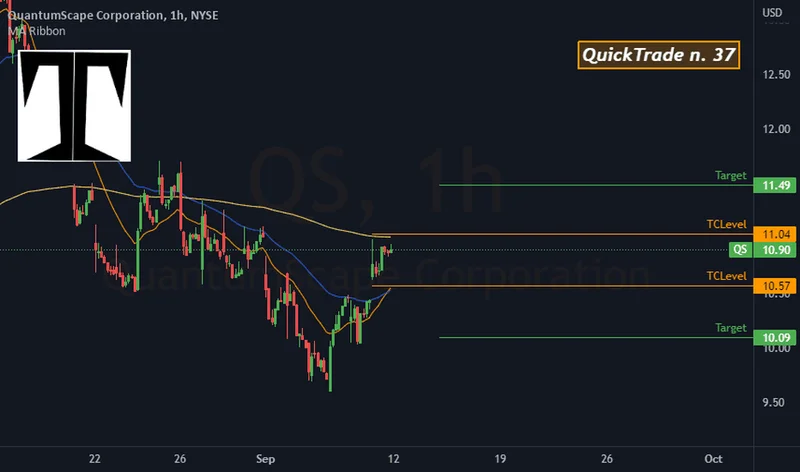
A single press release can add a billion dollars to a company’s valuation. Sometimes, it can add more. In the case of QuantumScape (NYSE: QS), the developer of solid-state lithium-metal batteries, its recent announcement of a partnership with Corning sent the `qs stock price` surging. The market’s reaction was immediate and unambiguous: a single-day jump of over 16%, capping a period of explosive growth. The stock has more than doubled in three months—to be more precise, the year-to-date performance as of the announcement was up 122.38%.
This is the kind of price action that commands attention. The narrative is straightforward. QuantumScape, a company promising to revolutionize the electric vehicle battery, has teamed up with Corning, a 170-year-old materials science giant, to mass-produce the single most critical component of its technology: the ceramic separator. For a pre-revenue company perpetually under scrutiny for its ability to scale, this appears to be a monumental step. It’s an endorsement from a manufacturing titan. It’s a tangible move from the lab bench toward the assembly line.
The market has priced this news not as a step, but as a giant leap. With a market capitalization now fluctuating between $7 and $8 billion, investors are placing a significant premium on the company’s future. The core question, then, is not whether the Corning deal is good news—it is unequivocally a positive development. The question is one of magnitude. Does this single partnership sufficiently de-risk QuantumScape’s path to commercialization to justify a valuation that rivals established, revenue-generating industrial firms? My analysis suggests a significant discrepancy between the narrative and the operational realities that remain.
Compelling Stories, Conspicuously Missing Numbers
Deconstructing the Catalyst
To understand the valuation, we must first dissect the partnership itself. QuantumScape’s entire technological premise rests on its proprietary solid-state separator. Unlike the polymer separators in conventional lithium-ion batteries, this thin, flexible ceramic sheet is meant to prevent dendrite formation, enabling the use of a pure lithium-metal anode. The theoretical benefits are immense: higher energy density, faster charging, and improved safety. The challenge has always been manufacturing this delicate ceramic material with perfect consistency, at massive scale, and at a viable cost.
Enter Corning. Partnering with a world leader in glass and ceramics manufacturing is an intelligent strategic move. It outsources a monumental production challenge to an entity with the requisite expertise. This agreement aims to jointly develop manufacturing capabilities for these separators. It signals that QuantumScape’s technology has passed a critical due diligence threshold with a serious, experienced partner.
And this is where my analysis hits a wall. The press releases from both QuantumScape and Corning are heavy on synergistic language—"shared spirit of innovation," "building the foundation for scalable production"—but are conspicuously light on financial commitments or specific volume targets. I've looked at hundreds of these partnership announcements, and the absence of quantifiable targets is a recurring flag for deals that are more about narrative management than immediate industrialization. We don't know the capital expenditure involved, the timeline for high-volume output, or the unit economics of the separators produced under this arrangement. The market has filled in these blanks with the most optimistic assumptions possible.
This pattern of high-impact demonstration followed by scant operational detail is becoming a hallmark of the QuantumScape strategy. We saw it at the IAA Mobility conference in Munich. Volkswagen’s battery subsidiary, PowerCo, showcased a Ducati V21L race motorcycle powered by QuantumScape’s cells. As a piece of marketing, it was brilliant. The image of a high-performance electric motorcycle is visceral and compelling. But as a data point for investors assessing mass-market viability, it’s thin. A custom-built race bike (a single prototype, to be clear) is a controlled environment. It does not provide data on cell performance variability, degradation over thousands of cycles in a commercial vehicle, or, most importantly, the cost and yield of producing the cells that went into that specific battery pack.
A Valuation Untethered from Manufacturing Reality
The Valuation Equation
The market seems to be conflating proof-of-concept with proof-of-scale. QuantumScape has demonstrated that its technology works in a lab and in a single motorcycle. It has now secured a partner to help solve one piece of the manufacturing puzzle. But the path from here to mass production is a minefield of unproven, interlocking steps. Making the ceramic separator is step one. Integrating that separator with the cathode and the lithium-metal anode into a complete cell is step two. Assembling those cells into reliable, safe, and cost-effective battery packs is step three. Doing all of this at a Giga-factory scale with yields above 99% is the final, monumental challenge.
The Corning deal addresses only a fraction of the first step.
Yet, the company’s $8 billion valuation implies that successful execution of all subsequent steps is a foregone conclusion. Consider the anchor customer, Volkswagen. Its battery unit, PowerCo, has expanded its collaboration with QuantumScape, committing an additional $131 million to accelerate the development of the QSE-5 battery cell. This is a significant vote of confidence. But let’s place that number in context. Building a single, large-scale battery factory costs billions, not millions. The investment from VW (reported at $131 million) is substantial for a development-stage company but represents a rounding error in the grand scheme of automotive manufacturing investment.
Investor sentiment, particularly in online forums like the `qs stock reddit` communities, often dismisses these concerns. The discourse is focused on the paradigm-shifting potential of the technology, drawing parallels to the early days of `tsla stock` or `nvidia stock`. The narrative is that of inevitable disruption. But this qualitative sentiment overlooks the quantitative realities of manufacturing. Unlike software, where products can be scaled with near-zero marginal cost, scaling hardware, especially advanced materials, is a brutal, capital-intensive process governed by the unforgiving laws of physics and economics.
QuantumScape is targeting field testing of its cells in 2026. This means meaningful revenue is, at best, several years away. An investment in QS today is not a bet on the technology itself, which appears promising. It is a high-premium wager that the company will navigate the labyrinth of scaled manufacturing with near-perfect efficiency, on time, and on budget. The current `qs stock price` has absorbed all the potential upside of a flawless execution, leaving little margin for the inevitable delays, cost overruns, and yield problems that plague even the most experienced manufacturers. The partnership with Corning is a logical and necessary step, but it is just one step on a very long and uncertain road. The market has priced it as the destination.
---
Priced for a Perfect Future
The Corning partnership is a validation of QuantumScape's lab-scale science, not its industrial-scale viability. The current valuation is a speculative instrument trading on a narrative of flawless execution years in advance. It has priced in the destination while the company is still mapping the route. An investment at these levels is not a stake in innovation; it is a bet against the statistical realities of complex manufacturing. The odds are not favorable.
Reference article source: