
Article Directory
# Is Rigetti's $11.5 Billion Valuation a Quantum Leap of Faith?
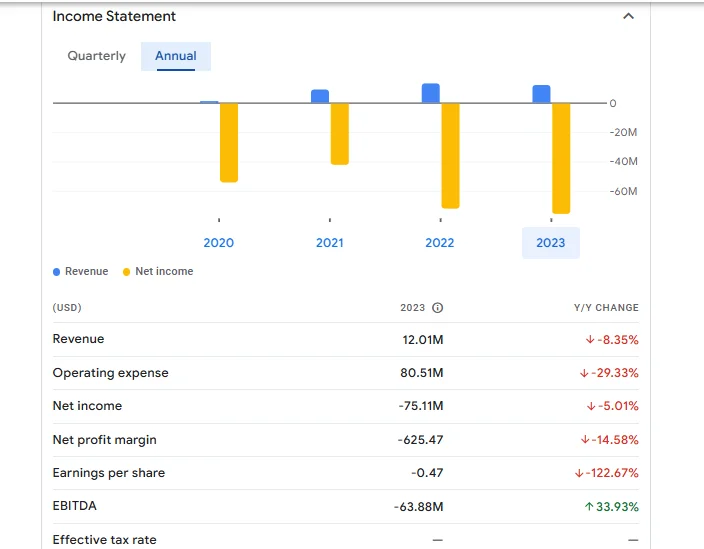
There's a number that’s been rattling around in my head for the past week: $11.5 billion. That’s the approximate market capitalization Rigetti Computing (RGTI) touched recently. Then there’s another number: $3.3 million. That’s the company’s total revenue for the first half of 2025.
Let’s be clear. A valuation that is over 3,000 times its annualized revenue run-rate isn't just an outlier; it's a statistical anomaly that demands scrutiny. The stock itself has been on an astronomical tear, up roughly 2,500% over the last 12 months—to be more exact, some reports cite a 4,457% increase depending on the measurement window. The trading volume has exploded, with the hum of servers processing buy orders creating a deafening roar of market excitement.
Investors are clearly not buying the company Rigetti is today. They’re buying a story about the company it might become a decade from now. They’re betting on the dawn of the quantum age, a technological shift so profound that Bank of America has called it "the most important technological race of our generation." But as someone who has spent a career looking at numbers, I have to ask a simple question: Does the math support the narrative?
Deconstructing the Catalysts
The recent frenzy can be traced to a flurry of positive, albeit modest, news. In late September, Rigetti announced $5.7 million in new orders for its Novera 9-qubit quantum computers and a separate $5.8 million contract with the U.S. Air Force. The market reacted as if the company had just cured cancer. The stock soared, adding billions in market value on the back of contracts that, combined, total just over $11 million.
This reaction is a fascinating study in market psychology. It’s like seeing a single drop of rain and immediately pricing your house for a biblical flood. The scale of the response is completely divorced from the stimulus. These deals, while validating Rigetti’s technology and demonstrating a path toward commercialization, are financially trivial for a company valued in the same league as established, profitable enterprises. What level of future revenue is the market actually pricing in at an $11.5 billion valuation? And how many of these small government and research contracts would it take to even begin to justify it?
Wall Street analysts seem to be grappling with this same cognitive dissonance. The consensus rating on Rigetti is a "Strong Buy," with five of six analysts tracked giving it a bullish rating. Yet, the average 12-month price target hovers around $20. With the stock trading in the $35-$40 range, this implies that the very analysts recommending the stock believe it’s poised for a significant correction. The only notable exception is B. Riley’s Craig Ellis, who raised his target to a street-high of $35, arguing that the technology is advancing toward commerciality faster than expected. Rigetti Computing Stock (RGTI) Adds Quantum Torque to Extend Rally
This is a classic disconnect. The qualitative story is compelling—quantum computing is the future!—but the quantitative reality is that the stock has run far ahead of any reasonable, near-term financial model. Analysts are effectively saying, "We love the long-term story, but we can't make the numbers work at this price."
The Balance Sheet's Quiet Warning
If you strip away the stock chart and the press releases, Rigetti’s financials paint the picture of a very early-stage R&D venture. In its most recent quarter (Q2 2025), the company generated $1.8 million in revenue while posting a net loss of nearly $40 million. Its gross margins have collapsed from 64% to 31% year-over-year. This is a company burning cash to build a future, not one generating profits today.
The bull case rests almost entirely on its balance sheet. Thanks to a series of capital raises, including a $350 million at-the-market offering, Rigetti is sitting on a formidable pile of cash—$571.6 million as of June 30, with zero debt. This gives it a long runway to fund its operations and R&D without immediate financial pressure. It's a war chest designed to survive the long, cold winter before quantum computing becomes commercially viable, a period the company’s own CFO suggests could be another "four to five years."
But while the company has been raising capital, its insiders have been doing the opposite. And this is the part of the data that I find genuinely puzzling. In the last 90 days, insiders have sold 457,624 shares worth about $8.5 million. Director Thomas Iannotti sold 100,000 shares, reducing his stake by 87%. Director Michael Clifton sold 75,000 shares. While some selling is expected for diversification or tax purposes (the standard C-suite explanation), the timing and scale here are noteworthy. Selling millions of dollars in stock directly into a historic, hype-fueled rally is a data point that shouldn't be ignored. If the long-term story is so compelling, why are the people with the most information reducing their exposure so dramatically at these prices?
Sure, large institutions like Vanguard and BlackRock have increased their positions. But much of this is likely passive index fund buying or part of a broader, speculative tech basket. It doesn’t necessarily reflect the same high-conviction analysis as an insider choosing to sell a significant portion of their personal holdings.
The Valuation Defies Gravity
Let's be blunt. Rigetti's current valuation is mathematically indefensible based on any traditional metric. A price-to-sales ratio north of 3,000x is not a sign of a healthy, growing business; it's the signature of pure, unadulterated speculation. The company is being valued not on its performance, but on its potential to capture a piece of a market that barely exists today.
Buying RGTI at these levels isn't an investment; it's a lottery ticket. The prize could be enormous if Rigetti becomes a dominant force in the quantum era. But the price of that ticket currently reflects odds that are far too generous. The market has priced in not just success, but overwhelming, world-changing dominance, leaving absolutely no margin for error, delays, or competition from behemoths like Google and IBM.
The technology is real. The promise is profound. But the valuation is a fantasy. For now, Rigetti Computing is a fascinating science experiment attached to a speculative financial instrument, and it’s critical not to confuse the two.