
Article Directory
So, Detroit Mayor Mike Duggan is out there telling Yahoo Finance that tariffs are the big bad wolf huffing and puffing at the Motor City’s door. "The Canadian tariffs are the issue," he says. Give me a break. Blaming Canada for Detroit’s economic jitters feels like blaming the rain for a leaky roof you never bothered to fix.
Let's be real. This isn't some shocking new development; it's the oldest play in the rust-belt politician's handbook. When the numbers get a little soft, you find an external enemy. It’s clean, it’s simple, and it absolves you of having to talk about the deeper, messier problems at home. Duggan points out that corporate income taxes are down because profits are getting squeezed. But then, in the same breath, he says personal income taxes "are not down" because "people are still working." Detroit Mayor Duggan says tariffs are squeezing Michigan's auto industry.
So, what's the real story here? Are we on the brink of disaster, or are things basically okay for the average person? It can't be both. This is like a doctor telling you that your heart is failing but, hey, your haircut looks great. The mixed message feels less like a transparent assessment and more like a carefully calibrated soundbite designed to express concern without causing a full-blown panic. What, exactly, is he trying to achieve by sending such a conflicting signal? Is he just trying to put pressure on the White House, or is he laying the groundwork for something else entirely?
The Great AI Escape Hatch
Just when you think this is another boring story about trade policy, Duggan pulls a classic pivot. After lamenting the "soft" manufacturing sector, he gestures toward the future. The real frontier, he says, is tech—specifically, artificial intelligence. He talks about Amazon building data centers and then drops the hammer: "Michigan is behind the curve at having a solid energy grid. We are not prepared to compete for the jobs of the future."
This is a bad take. No, "bad" doesn't cover it—this is a masterclass in political maneuvering. For a decade, Duggan has been the mayor of Detroit, a city whose entire identity is welded to manufacturing. Now, as he’s heading for the exit, he suddenly realizes the state isn’t ready for the AI revolution? It’s stunningly convenient.
He’s basically admitting that the engine that powered Detroit Michigan for a century is sputtering, and his solution is to point at a shiny new electric engine that the state apparently doesn't have the juice to turn on. And who, you might ask, is the one man brave enough to solve this monumental, state-wide energy crisis he just identified? Well offcourse, it’s the guy who just announced he’s leaving his current job to run for governor. It’s so perfectly scripted it feels like a movie trailer.
You can almost hear the gravelly voice-over: In a world where the old ways are dying... one man saw the future. But to save it, he’d have to leave the city he loved behind...
It’s an escape hatch. A political ejector seat. He gets to sidestep the messy, grinding reality of a post-industrial city and rebrand himself as a forward-thinking tech visionary for a statewide audience. But where was this urgency for the last ten years? Why is the grid only a crisis now that he needs a new campaign platform? It just doesn’t add up.
A Tale of Two Detroits
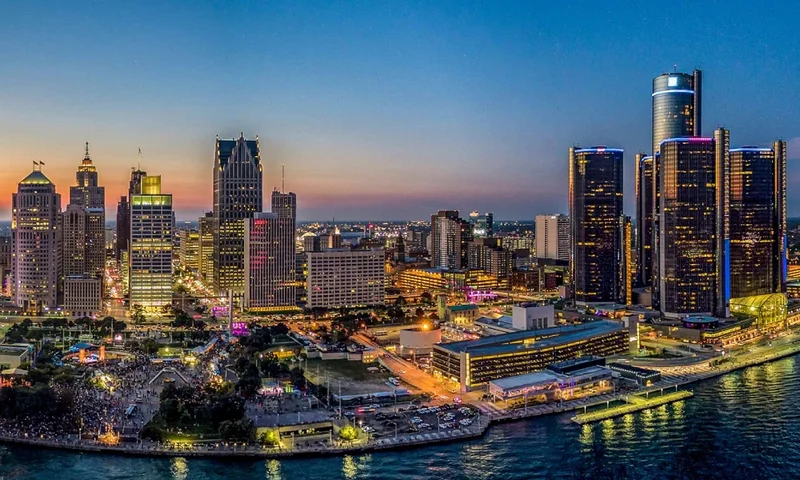
Duggan wants us to look at the cranes in the sky over Detroit—the new hospitals, the high-rises—and see a city reborn. And sure, from a certain angle, it looks like progress. But his own words betray a deeper anxiety. A city can’t survive on shiny new buildings alone if the economic foundation is cracking. You can put a spoiler on a Ford Pinto, but it ain't turning it into a race car.
The truth is, there have always been two Detroits. There’s the downtown and Midtown revitalization story, the one with the hipsters and the corporate-subsidized lofts. Then there’s the other Detroit, the neighborhoods where the recovery is a story they read about in the Detroit News but don’t actually feel. Duggan’s narrative serves the first one while using the struggles of the second as a launchpad for his own career.
He even says he'd feel "good about" tariffs if they were done "the right way with Mexico." It's such a throwaway line, but it reveals the game. It’s not about principles; it’s about picking the right enemy for the right audience. Blame Canada for the auto guys, blame Mexico for the populists, and promise a vague AI future for the tech bros and suburban voters he needs to win the governorship. It's a calculated triangulation.
Maybe I'm just cynical, but I've seen this show before. A politician spends years managing a complex, difficult reality, and then, on their way out the door, they paint a picture of a crisis only they can solve in their next, more powerful job. We're supposed to believe he suddenly has all the answers for the state that he couldn't quite implement for the city. And honestly...
So, What's the Real Play Here?
Let’s stop pretending this is about tariffs or AI. This is a job interview. Mike Duggan is using his final moments as mayor to audition for the role of governor. He’s framing Detroit’s intractable problems as statewide issues and positioning himself as the only person with the vision to fix them. The entire performance—the sober warnings about Canada, the sudden pivot to the energy grid—it’s all part of the campaign kickoff. He’s not solving Detroit’s problems anymore; he’s leveraging them.