
Article Directory
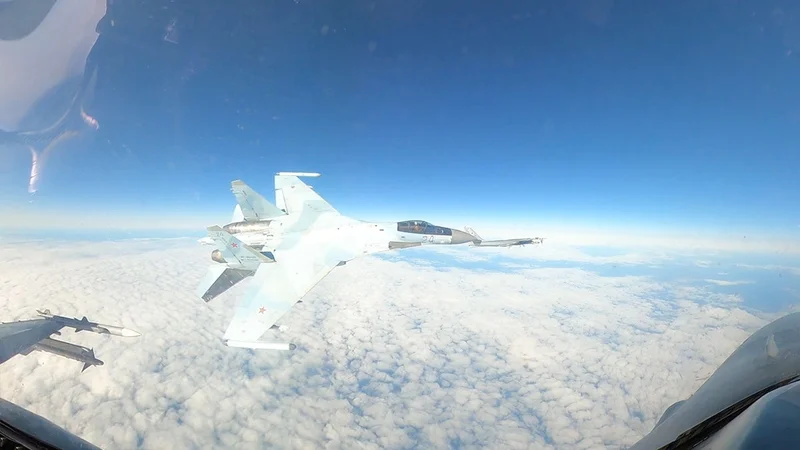
The initial report was clinical, almost sterile. On an otherwise unremarkable day, the North American Aerospace Defense Command (NORAD) detected and intercepted a formation of four Russian military aircraft operating off the coast of Alaska. The composition was standard for such an event: two Tu-95 strategic bombers, escorted by two Su-35 fighter jets.
NORAD’s response was robust and, by their own account, textbook. It involved a command-and-control E-3 aircraft, four F-16 fighters for the intercept, and four KC-135 tankers for support. The critical detail, which NORAD’s press release made sure to highlight, was that the Russian aircraft remained in international airspace. They entered the Alaskan Air Defense Identification Zone (an internationally recognized buffer of airspace where aircraft are tracked for national security purposes), but never breached sovereign U.S. or Canadian territory.
The official statement from NORAD was designed to be calming. This activity, they noted, “occurs regularly and is not seen as a threat.” A routine occurrence. A non-event. The data point was logged, the press release was issued, and the system returned to a state of equilibrium.
But a single data point is rarely the story. The story is the trend line. And the trend line here is beginning to look less like a stable equilibrium and more like a systematic escalation.
This Alaskan intercept was the ninth time this year NORAD has publicly reported tracking Russian aircraft near the continent. To be more precise, it was the third such incident in the last month alone. A frequency that accelerates from an average of once every 40 days to once every 10 days is not "routine." It is a statistically significant change in behavior. And I've analyzed market signals for years; this pattern of escalating, low-cost probes feels eerily familiar. It’s a classic strategy for testing the outer bounds of a competitor's risk tolerance without triggering a full-scale response.
The narrative of normalcy begins to completely break down when we widen the aperture from the Bering Strait to the Baltic Sea. The Alaskan incident is not an outlier; it is one node in a rapidly expanding network of provocations.
Plotting the Data: A Signal, Not Random Noise
A Pattern of Coordinated Probing
While NORAD was managing its "routine" intercept, its NATO counterparts in Europe were logging a flurry of much more aggressive incursions. The dataset from September alone is illustrative.
On September 9, Poland reported 19 separate intrusions by Russian drones, eventually shooting some of them down. Four days later, on September 13, Romania scrambled its F-16s after a Russian drone crossed into its sovereign airspace. On September 19, Estonia’s air defense systems tracked three Russian MiG-31 jets violating their airspace for a full 12 minutes—the fourth such violation this year, according to Tallinn. Denmark, meanwhile, has been dealing with a series of drone incursions near four of its airports, and while attribution is difficult, officials have not ruled out Russian involvement.
This is where the official narrative from any single event becomes misleading. A lone drone over Romania or a bomber formation in the ADIZ can be dismissed. But when you plot the events on a map and a timeline, the picture changes from a series of isolated dots into a clear, directional vector. This is not random noise. It is a signal.
The response from the political sphere reflects this underlying data far more accurately than the placid military press releases. Donald Trump, never one for nuance, warned that such incursions could mean “big trouble” and called for NATO members to shoot down violating aircraft. This might be dismissed as simple rhetoric, but the incoming NATO Secretary General, Mark Rutte, echoed the sentiment, stating that shooting down Russian aircraft is a valid option if other measures are exhausted.
The Kremlin, for its part, is not hiding its intent. Spokesperson Dmitry Peskov’s statement that "Nato is fighting against Russia" is not a complaint; it is a framing device. It provides the justification for these actions, recasting them from unprovoked probes into defensive maneuvers against a hostile alliance. Natia Seskuria, an associate fellow at RUSI, provides the most coherent interpretation: these are deliberate, coordinated tests of Western response times and, more importantly, of NATO’s political unity.
And the test appears to be working. In response to the violations, both Poland and Estonia took the significant step of invoking Article 4 of the NATO treaty. This is not a trivial action. Article 4 is the alliance’s formal mechanism for emergency consultation when a member feels its "territorial integrity, political independence or security is threatened." It’s the official alarm bell.
The invocation of Article 4 by two separate member states in response to these aerial incursions is the most compelling piece of data we have. It tells us that, behind the scenes and away from the calming press releases, the governments on the front line are not interpreting these events as "routine." They are interpreting them as a direct and escalating threat that requires a unified alliance response. The discrepancy between NORAD’s public posture on the Alaskan ADIZ and the formal treaty actions being taken in Europe is vast. One is a message of de-escalation for public consumption; the other is a procedural preparation for conflict.
---
An Asymmetry of Calculation
The core analytical error is to continue treating these events as individual data points. The risk is not that a single Tu-95 bomber will launch an attack off the coast of Alaska. The risk is in the frequency. By conducting nearly a dozen probes in Alaska and dozens more across Europe, Russia is normalizing a state of high-tension contact. Each of these "routine" intercepts carries a non-zero probability of miscalculation—a pilot error, a system malfunction, an overly aggressive maneuver. When you run that simulation once, the risk is low. When you run it dozens of times a year, the cumulative probability of a catastrophic error trends dangerously upward. The official narrative of "routine" isn't just inaccurate; it's a dangerous form of risk management that miscalculates the true nature of the threat.
Reference article source: