
Article Directory
The market holds its breath. As of this morning, September 26, 2025, European indices are a mixed bag, a messy watercolor of minor gains and losses. The usual sectors are playing their parts: technology and healthcare, from SAP to Siemens Healthineers, are showing a degree of resilience, while energy and financials wobble under the weight of fluctuating commodity prices and regulatory headwinds. All eyes, as they so often are, turn west, waiting for the latest U.S. inflation data to drop. It’s a familiar state of tension, a low hum of uncertainty that has become the background noise of modern capital markets.
This is the terrain. This is the volatility that, according to historical precedent, should breed caution. Yet a recent study from Fidelity Investments paints a picture not of uniform anxiety, but of a deep, structural schism in market psychology. The headline figure suggests a surprising degree of optimism: 64% of self-directed investors expect their portfolios to perform the same or better in the coming months. But that aggregate number is a dangerous oversimplification. It masks a fundamental, almost philosophical, divide between two distinct cohorts of market participants. It masks the chasm between the bullish and the wary.
Experience vs. The Feed: A Fundamental Split in Investor Methodology
The Anatomy of Two Investors
The data, when disaggregated, is stark. On one side, we have the tenured investor, defined as someone with more than a decade of experience. Nearly half of this group—47% to be exact—state their primary goal for 2025 is limiting losses. For them, volatility is not a surprise; 69% view it as an expected feature of the market landscape. They have seen the charts from 2008, when the S&P 500 shed roughly 57% of its value from peak to trough. They remember the sickeningly rapid 30% drop in March 2020. Their caution is not theoretical; it is scar tissue.
On the other side, we have the new investor, with five or fewer years in the market. This group’s reality is shaped by a different set of experiences. Their primary exposure has been to a post-2020 market characterized by unprecedented stimulus, meme-stock phenomena, and the normalization of crypto assets. Their response to the current environment is, accordingly, divergent. Forty-eight percent are actively seeking higher-growth stocks. They are five times more likely than their tenured counterparts to be planning their first foray into margin and options trading.
And this is the data point that, I admit, gives me pause. It’s the source of their decision-making inputs. More than one-third of these newer investors—34%, if we're being precise—report making most of their investment choices based on social media. This compares to just 10% of the tenured group. This is not merely a difference in news consumption. It is a fundamental divergence in methodology. One group operates on a framework of historical performance and risk management. The other operates on a framework of narrative, sentiment, and social proof, delivered in short-form video and algorithmically-curated feeds.
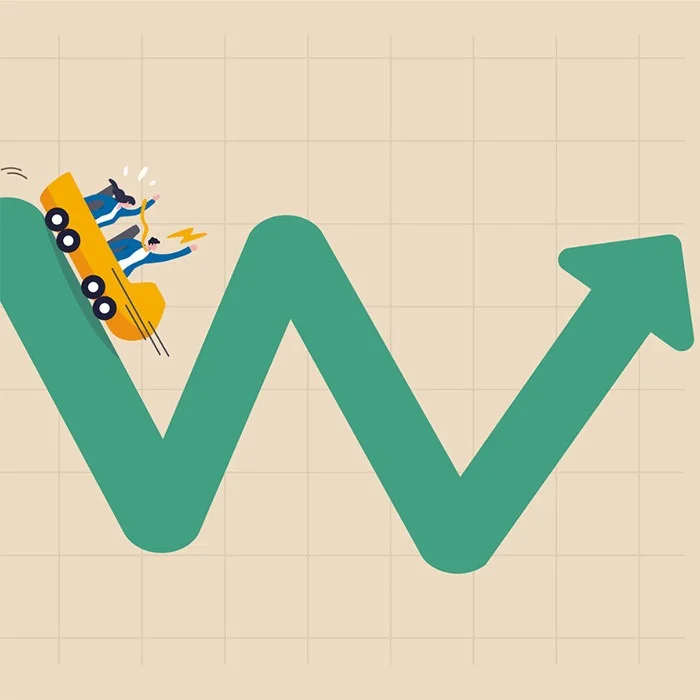
This leads me to a necessary methodological critique of the Fidelity study itself. The report delineates between self-described "successful" and "unsuccessful" investors. It finds that the "successful" are less likely to sell during dips and prioritize a stock's historical performance. The "unsuccessful" are more likely to react to general market sentiment and news coverage. The correlation is clear, but the self-reporting nature of the "successful" label is a significant variable. Is success defined by recent gains in a bull market, or by capital preservation across multiple cycles? The answer to that unasked question is critical. An investor who rode a single speculative asset to a 500% gain might call themselves successful, but their process is indistinguishable from the one the data labels "unsuccessful."
An Asymmetry of Risk Models
An Asymmetry of Risk Models
This isn't just about age; it's about the data sets used to build an internal risk model. The tenured investor's model is weighted by events like the U.S.-China trade war, Brexit, and even smaller shocks like Hurricane Katrina (which prompted a 5% drop in the S&P 500). They see central banks raising interest rates to combat inflation and recognize the historical parallel to the punishing early 1980s. Their model is calibrated to survive downturns.
The newer investor's model appears to be calibrated for upside. Their familiarity with non-traditional assets is a clear indicator: 72% are familiar with crypto, versus only 35% of the seasoned cohort. They see market dips not as a warning but as an opportunity, with Fidelity traders in this demographic maintaining a strong buy-the-dip impulse (a 1.83 buy-sell ratio, to be specific) during the turbulence in April 2025.
What this newer cohort may not fully price in are the structural complexities of the current market. They see the disruptive potential of AI and electric vehicles, which is real, but may overlook the second-order effects of how capital markets actually function. Take Algorithmic Trading (AT). Research shows that AT, which dominates modern trading volumes, can reduce certain types of price volatility. However, it often does so at the cost of market depth, acting as a liquidity demander rather than a provider in times of stress. This is a subtle but crucial distinction. The mechanisms that keep markets orderly, like the liquidity provided by market makers, are being altered by forces that are invisible to anyone whose analysis is based on sentiment rather than market structure. The ecosystem itself is changing.
We are therefore observing a massive, real-time experiment. One group, the wary, is navigating 2025 with a map built from the wreckage of past crises. The other group, the bullish, is navigating with a map crowdsourced in real-time from digital platforms, seemingly convinced that the terrain has fundamentally and permanently changed. The VIX, the market's "fear gauge," may measure expected volatility, but it cannot measure this underlying divergence in the perception of risk. The same data point—a looming inflation report—is processed through two radically different models, yielding one conclusion of caution and another of opportunity.
The Experience Premium ###
The discrepancy between these two investor classes is not a simple disagreement on strategy. It is a fundamental gap in risk calibration. The confidence of the newer investor is a function of a dataset limited to a historically anomalous period. Their reliance on social media for decision-making is not an evolution; it is an abandonment of rigorous analysis in favor of narrative momentum. The lessons the tenured group paid for in 2000, 2008, and 2020 are now being offered again. The tuition, as always, is non-negotiable.
Reference article source: